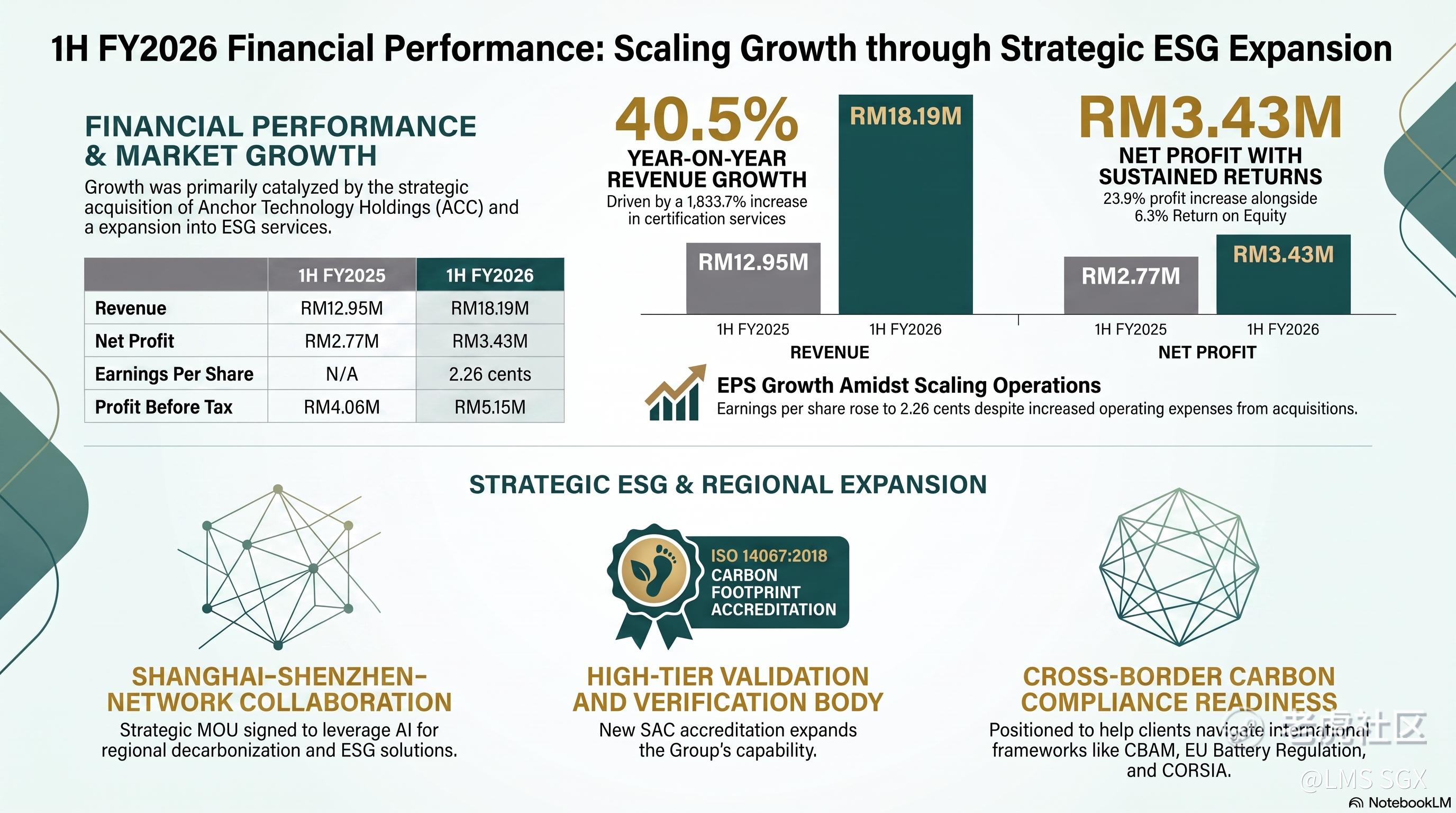
$LMS Compliance(LMS.SI)$ In an era where many corporations are grappling with "ESG fatigue" and the daunting complexity of global regulations, LMS Compliance Ltd. is finding significant opportunity in the friction. The company recently reported a 40.5% revenue jump to RM18.19 million for the first half of FY2026. While these headline figures suggest a business in high gear, the real story lies in the strategic shifts and structural investments happening beneath the surface.
This article moves past the primary financial data to identify the four strategic truths driving LMS Compliance’s current trajectory. As a specialist firm navigating a tightening regulatory net, the firm's recent performance reveals how a deliberate pivot toward carbon services is reshaping its financial profile. We will examine why their "buy vs. build" approach and regional expansion are essential steps in maintaining their competitive moat.
1. The 1,833% Explosion in Certification Services
The most striking figure in the 1H FY2026 report is the performance of the "Certification and Consultancy Services" segment. This division saw a staggering 1,833.7% increase, with revenue rising by RM5.44 million. This surge was primarily driven by the strategic acquisition of Anchor Technology Holdings Co., Limited (“ACC”), which was completed on 11 July 2025.
In high-stakes compliance markets, the "buy vs. build" strategy is often the most viable path to rapid scaling. By acquiring specialised capabilities rather than developing them in-house, LMS has bypassed years of accreditation hurdles and market-entry barriers. While this acquisition drives the Group’s growth, it is worth noting that legacy segments saw minor friction, with Testing and Assessment down 2.5% and SaaS revenue declining 22.6%.
"Our performance in the first half of 2026 reflects the resilience and adaptability of LMS Compliance. The steady revenue growth and a sustained profit margin despite challenging market conditions underscore the strength of our diversified service offerings."
— Dr. Louis Ooi, CEO of LMS Compliance
2. The "Margin Squeeze" of Rapid Expansion
A counterintuitive trend emerged alongside the top-line success: while revenue climbed 40.5%, net profit grew at a slower rate of 23.9%. Consequently, the net profit margin contracted from 21.4% to 18.9%. This highlights a classic "scaling tax" where upfront investments in people and infrastructure precede the full efficiency of a larger organisation.
The Group’s growth was accompanied by specific operational costs necessary for regional dominance:
* Employee benefits: Increased by 37.2% (up RM1.92 million) to integrate personnel from new subsidiaries.
* Materials and subcontractors: Costs rose 68.4%, directly reflecting the higher volume of certification projects.
* Strategic Visibility: A RM0.61 million increase in "other expenses" was driven largely by exhibition expenses, a critical lead-generation investment for market expansion.
* Finance & Intangibles: Amortisation of intangible assets reached RM0.44 million, while finance costs jumped 160.8% due to interest on financial liabilities and leases.
3. The "Shanghai–Shenzhen–Singapore" ESG Triangle
In April 2026, LMS Compliance moved to bridge the gap between Southeast Asian and Chinese markets by signing a strategic Memorandum of Understanding (MOU) with ACC Shanghai and Shenzhen GDR Carbon Asset Co., Ltd. This partnership establishes a "Shanghai–Shenzhen–Singapore" collaboration platform designed to leverage AI and carbon asset management.
As international frameworks become more stringent, LMS is positioning itself as a "regulatory translator" for cross-border trade. This tri-city collaboration enables the firm to help businesses navigate complex mandates, including the Carbon Border Adjustment Mechanism (CBAM) and the EU Battery Regulation. Notably, it addresses high-stakes requirements like CORSIA (Carbon Offsetting and Reduction Scheme for International Aviation), placing LMS at the centre of global aviation compliance.
4. Carbon Footprinting: Moving Beyond General ESG
In May 2026, LMS Compliance secured accreditation from the Singapore Accreditation Council (SAC) for ISO 14067:2018 (Carbon Footprint of Products). This is a critical evolution from their existing ISO 14064-1:2018 verification, which focuses on general corporate-level reporting. By moving toward product-specific verification, the firm is targeting a much more granular and valuable level of data.
Product-level carbon footprinting is the primary tool for "Scope 3" supply chain transparency, which is increasingly required for international market access. While corporate reporting provides a broad overview, ISO 14067 enables rigorous verification of individual items. This capability enables clients to meet stringent disclosure requirements with precision, moving the needle from vague sustainability claims to verified, product-specific data.
Conclusion: The Future of Compliance
The 1H FY2026 results signal a fundamental transformation: LMS Compliance is shifting from a regional laboratory-testing firm to a regional powerhouse for ESG and carbon compliance. While the company maintains a healthy net profit of RM3.43 million, it is clearly prioritising long-term market positioning over short-term margin maximisation. This is supported by a solid financial foundation, including a Return on Equity (ROE) of 6.3% and a Return on Assets (ROA) of 5.4%.
As the industry evolves, one question remains for observers of the compliance sector: In an era where "greenwashing" is under fire, is specialised, high-accreditation verification the only remaining moat for service providers? For LMS Compliance, the heavy investment in technical accreditations suggests they believe the answer is a definitive yes.
精彩评论